

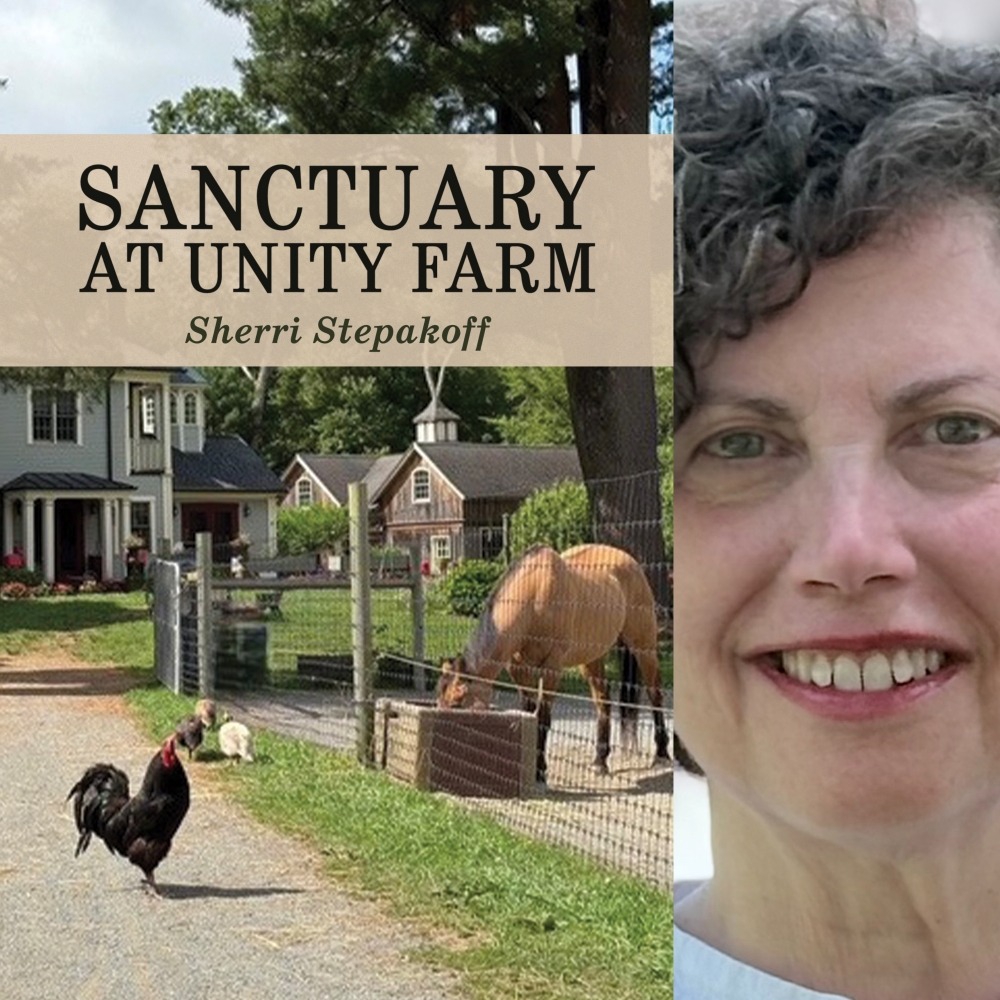
Sherri Stepakoff is a Boston area poet whose poems have appeared in Passagers, Off the Coast, Notable Works’ environmental anthologies Voices of the Earth: The Future of Our Planet (III and IV), and elsewhere. She was awarded honorable mentions in the NFSPS Prouty Memorial Contest (2024) and the Fish Publishing Poetry Contest (2023). She served as the inaugural poet in residence at Unity Farm Sanctuary. Debut collection.
PRAISE:
In Sanctuary at Unity Farm, Stepakoff has established herself as the William Blake of the Barnyard Set.
–Francisco Goldman, author of Monkey Boy
Sherri Stepakoff’s poetry is not just about a sanctuary, it is a sanctuary. This is a book to keep by your side and read, and then re-read. Her poems offer a place of comfort, of humor, of love and a reminder, as she wrote, of “the impulse to live on.”
–Jeffrey S. Cramer, editor of The Portable Thoreau
In her debut collection, Sherri Stepakoff documents the comfort her speaker derives from living among rescued animals who survive and find joy despite the challenges of their previous lives. Like the creatures who sing through brays, grunts, calls and cries, the poet sings her truth, too, always conscious of her role, to shape words artfully to give voice to deep emotions. Rhymed couplets, praise poem, meditation, villanelle, Ars poetica, free verse—Stepakoff skillfully deploys a range of poetic forms, giving strong proof of her raison d’etre: “I record these things, and some that I invent, in my poems.”
–Lynne Viti, poet laureate emerita of Westwood, Massachusetts
Ellen Jane Powers, Toward the Beloved (Finishing Line Press), Celestial Navigation (Cherry Grove) –
Sherri Stepakoff’s slim volume of poems (“Sanctuary at Unity Farm”), written while living as poet-in-residence at the Unity rescue farm, takes us through a journey of sanctuary — sanctuary from what might be life’s treadmill as a former attorney (“Review divorce discovery documents”), unspoken despair (“the pain must be held in your arms until it is dear”), and, perhaps too, expectations (“how long I will stay, who / or what will be left behind”). The place, and thus the poems, is both therapeutic and transformative.
I immediately felt a rhythm very much like breathing, beginning with the first scene-setting poem (“Sanctuary”), where the narrator “was embraced / like one baptized / by the steady pulse / of the animals waking / and sleeping.” Stepakoff makes use of stanza breaks and line breaks as if they too are breath—long and short pauses, like an undercurrent carrying the reader along into “a place that draws to it // a deepening, a slowing, / an acceptance of / like that slow-moving river / carrying revelations / with the current”).
Each poem carries emotion into that revelatory river, and it’s at this place of sanctuary that the current slows enough for poems to be written and “recall[ed] in tranquility,” to quote Wordsworth in the poem “The Desk.” What might have been a weighty emotional journey is instead buoyant with Stepakoff making good use consonance, repetition, rhyme & rhythm, and even includes a few of her own line drawings.
When the observer in “Geese Articulation” matches the rhythm of geese “swishing” and “sashay[ing]”, the delight is in the refrain that’s both geese and narrator are swishing and sashaying and exclaiming “Oh, yes, I do”. The poem, “Hineni” suspends us in a list from the sensory world: “when the stone frog plays its watery song” and “when the setting sun throws shadows long”); then brings us to the unspoken name of G-d: “your breath-filled name echoes with the breeze / As you search for me, I search too”); yet as the title suggests, “Here I am”, is a call of readiness for a transforming experience.
The fun couplet-based list poem, “How to Become a Mystic”, lets go, just as a mystic must do to experience unity with the godhead: “Play with a Ouija board at a slumber party / Hear from the beyond and throw the board out”. And the surprising last couplet brings us full-circle into the present moment of the farm.
There are poems of recovery (“No animals’ antics to describe the pain I’m in—“); discovery (“looking out at the paddocks and fields / that offer safety and relief”); sights (“No saddles worn on the rescue farm”); sounds (“buckets and dishes will bang and the calf’s bottles will swish”); smells (“grass-sweetened breath”); and what seems to me a noticing of what is beneath it all (“the voice sings to me You’re not alone…”).
By the closing poem, “Garden Prayer,” full of stark imagery (“bud-less trees with their gnarled limbs rooting in the sky”), each line praising nature’s natural “impulse to live on”, I am left, as a reader, in a garden that is both sanctuary and unity, so that I too can say Hineni.