

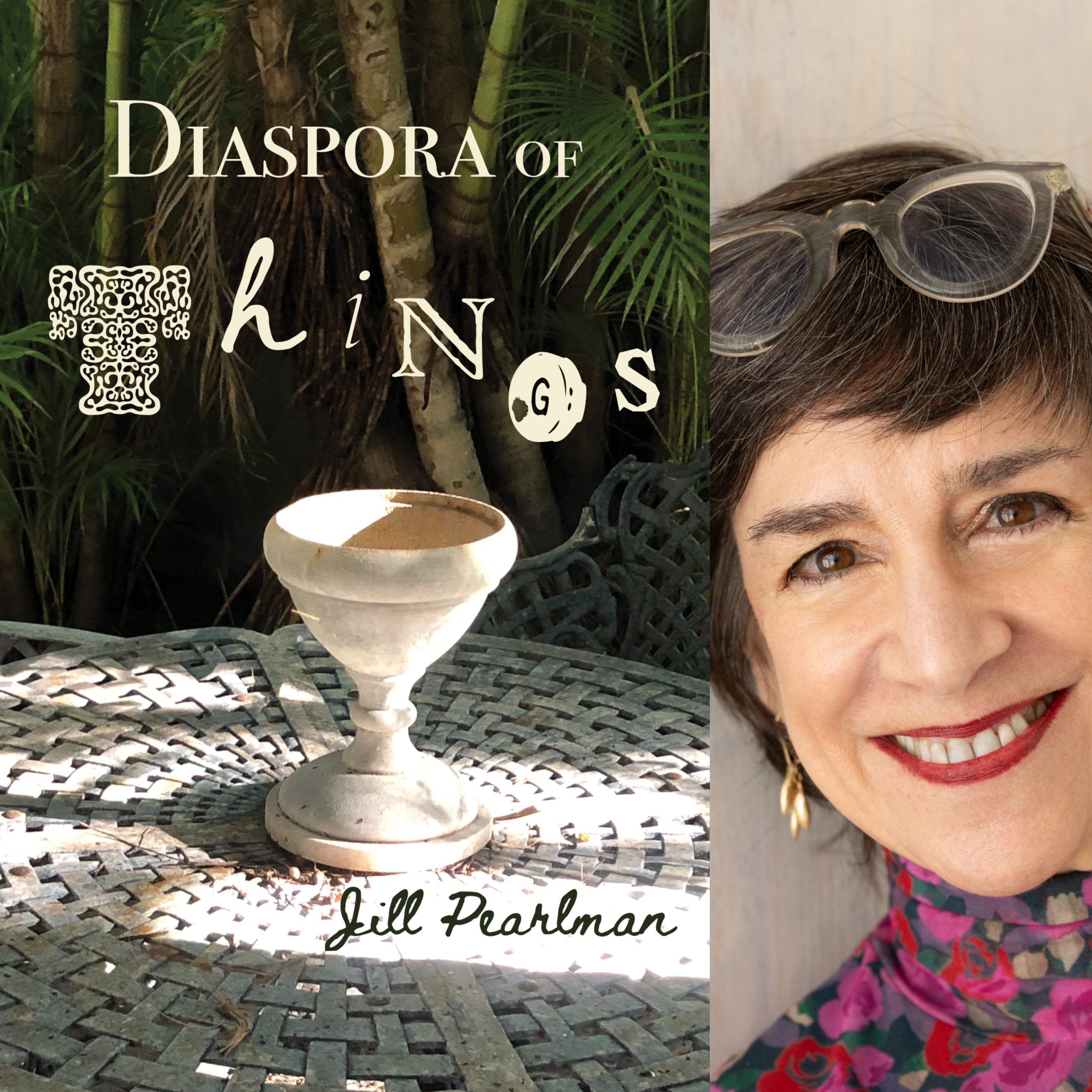
Jill Pearlman’s poems explore ecstasy in the decentered world and self. Originally from Pittsburgh, she has lived in New York, Paris and French Catalonia. Her poems (The Common, Salamander, Barrow Street, La Piccioletta Barca) wander the world as impatient travelers, reflecting voices of fluidity and transcultural values. She studied art history, worked as a music and arts journalist in New York and is the mother of two superb daughters.
PRAISE
Written in the midst of a loved one’s home being dismantled and her possessions dispersed, Jill Pearlman‘s poems are by turns filigreed and laden with the “thingy flesh” between lost and losing. Diaspora of Things evinces the immanence of objects “freed from the daze of possession,” holding close and honoring both the degree to which we imagine our lives by way of our possessions and the real role that our things play in binding us to the world and each other. Replete with grief, tenderness, and the self-bereavement that is intrinsic to living, Diaspora of Things is a tribute to our “stranger selves.”
–Kate Colby, author of I Mean and Reverse Engineer
Jill Pearlman‘s Diaspora of Things is part catalogue of objects–“Crystal birdspeak,” “Leopard stoolspeak”–and part meditation on the opulence of grief, as a daughter navigates family history while settling her mother’s estate. This is a collection about possessions and minor obsessions–evocative in its juxtapositions (as in a vase from Marshall’s at home next to the Frank Stella)–and a meditation on memory, emptiness, art and the mysteries of impermanence, where “perishability becomes a hardened thing.” Sadness is “laquered with elegance,” and even “the soft pencil” jottings of a “life together” urge the unsaid to be articulated. Diaspora of Things is a moving amalgam, in which the speaker asks “How to hold the self?” and–as intimate witness–brings the reader along, as she moves towards her own conclusion.
–Tina Cane, author of Year of the Murder Hornet
Jill Pearlman‘s poems mourn and reanimate her deceased mother. Through scraps of dialogue, they convey her mother’s wit and panache and appetite for life and they catalogue the “diaspora of things” her mother collected and loved. Among these are crystal birds, a jade flower bouquet, a silver lamp with a beaded shade, and “stacks and stacks of napkins—so beautifully ironed, the creases would break your heart.” The light cast by the objects throws into relief the contours of the poet’s loss, her realization that, through it all, she and her mother share “this fabric,/this flesh, this tissue”; the reader comes to understand the grieving process in new and startling ways.
–Jennifer Barber
Reviews
There are no reviews yet.