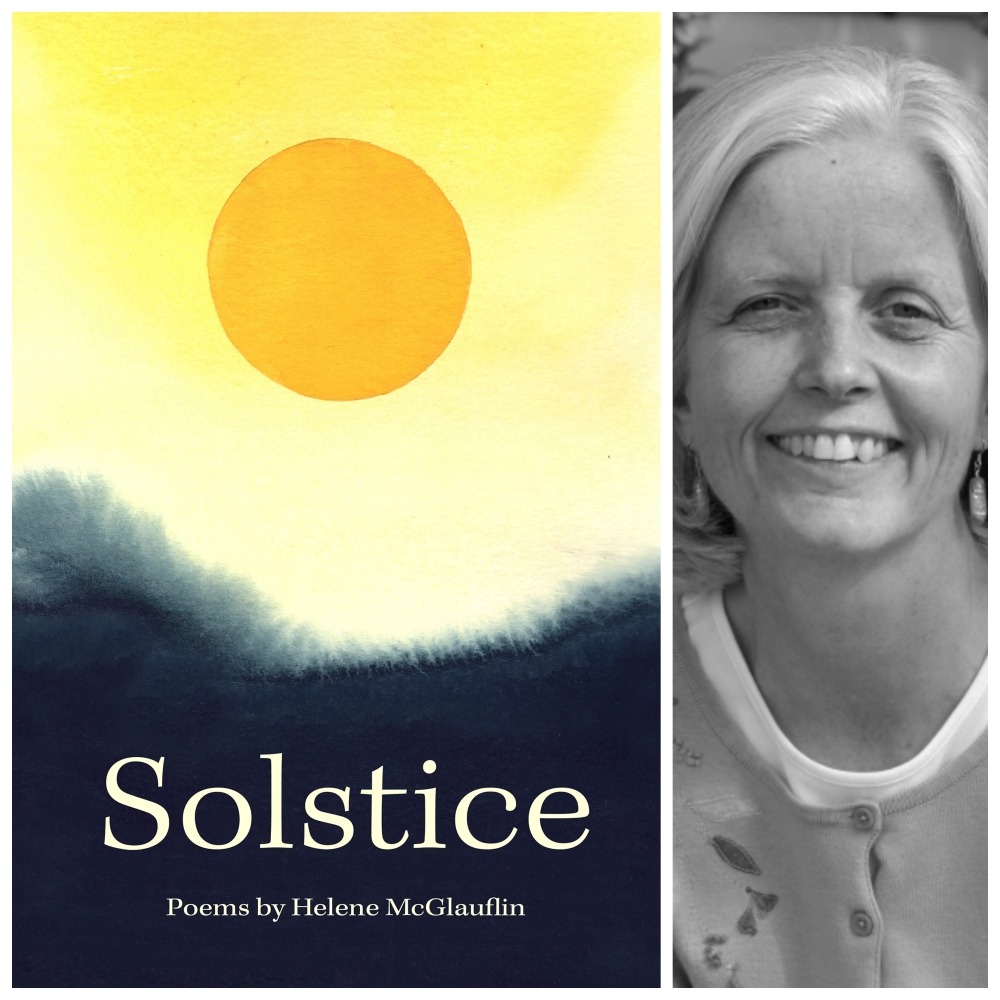
In her lovely poems, Helene McGlauflin reminds us of the mystery of darkness, that state in which the stars appear and bulbs lie, not dead, but dormant and waiting. These compelling poems reach out to their reader and offer fresh and surprising variations on the search for light in our dark hours. Nothing is excluded. There is “the honesty of sludge,” and a unique vision of the three wisemen relinquishing their pomp. In a poem addressed to the super moon, dated November 2016, the poet sees in the moon a “non-scorching reprimand” and asks, “How could we have mistaken darkness for light…?” The gift of at these poems is that they don’t. They search and discern, question and embrace, facing the darkness but moving steadily toward a sustaining light that is “luminous, waiting.”
–Betsy Sholl, As If a Song Could Save You.
In the Lateran relics collection, in Rome, there is a sealed tube. Within it, they say, is light from the star followed by the three kings – relics and miracles, always about faith … and light.
The poems in this collection sing light into darkness, but celebrate the darkness as well, singing out from that liminal space where things are always beginning, just before dawn, just before solstice, the time to “wait for sunrise, walk together into a future”
–Gary Lawless, How the Stones Came to Venice
Helene McGlauflin‘s Solstice takes us on a soulful journey into the yearnings of the human spirit to find light, hope, and peace in the midst of a changing and complex world, asking us to consider questions like “what is left after//virus rages/fire destroys/winds howl…hate spews”? Like in her poem “Root Cellar,” these poems quietly but confidently ask us to take stock of the spaces and things that restore us: “. . .as cold and despair lurk outside you, you/will never starve if you can descend, return to your store/sit in a corner among jars in the gloaming, trust the quiet,/the silent light as a promise from the root cellar”. And, like in her poem “A Single Star,” these poems insist on our ability to find “the quixotic promise visible at dusk . . .” and like “miners . . . find a beam as the mountain/crumbles underfoot and light abandons the shaft, then be cheered by/your capacity to save yourself and those around you from collapse.” These poems are very feminine in the way that they remind us that light and hope are products of a life lived simply, a life lived with the understanding that babies, community, and the natural world can indeed save us because “a single point of light in darkness matters.”
–Marita O’Neill, Evidence of Light


Reviews
There are no reviews yet.