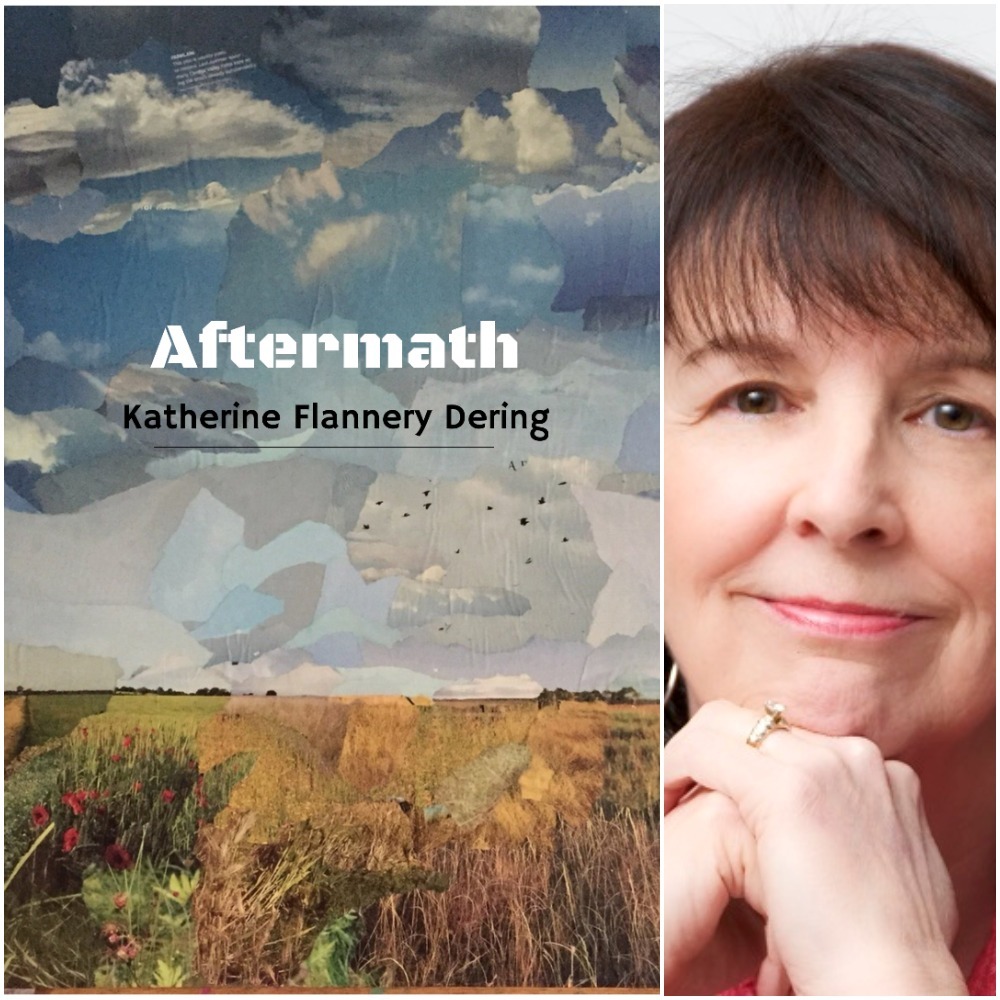
From remnants of loss, shreds of doubt and slivers of hope, Katherine Flannery Dering has fashioned a texturally complex and cumulatively moving poetic collage. The images and language in Aftermath are vivid and sure—a grieving sister becomes “an Inuit carving, / smooth and compact, / her back a soft curve”—even as these poems necessarily produce more questions about life (“How is this supposed to work?”) than answers. Here we experience a slice of lived history that, for all its difficulty, still, miraculously, vivifies.
–Scott Mason, author of The Wonder Code, recipient of the Touchstone Distinguished Book Award from The Haiku Foundation
Katherine Flannery Dering‘s poems give their full lyric attention to the natural world and shine a keen eye on the daily vividness of life. Birds at the feeder, boys on skateboards, an old cat, a stained bathrobe, a walk through a labyrinth, a boat ride on the lake—they all bring their meditations on the nature of existence, humming the low notes of grief and loss even as they illuminate the beauty and truth of the ordinary hours.
–Carla Funk, author of Gloryland, Apologetic, and The Sewing Room
Katherine Dering‘s beautiful collection Aftermath is a meditation on our search for connection, even as the losses pile up. What do we do when death surprises us? How do we reach across time and space to those who are gone? Through writing, perhaps, or maybe we hope to join them eventually in “a place among those/stars, floating through the light as it streams through the universe.” A lovely hope indeed.
–Laurel S. Peterson, Poet Laureate, Norwalk CT, author of Do You Expect Your Art to Answer?
This extraordinary poet asks many questions—How do I give comfort if I’m chopped to pieces? How do I grasp this vision? Did I expect to move through life without a mark? Where do I go from here?—in her quest for permanence and meaning amid the losses all around us. Many of life’s moments, and our children, are “loose atoms, always escaping.” But these poems urge us to live, despite the fact that “death waits just outside.” They urge us to “live for something.” And in the rich visions Dering gives us, such as the one of her family’s trip through the Simplon Pass in the Alps in the “1957 Plymouth station wagon under millions—a universe—of twinkling stars,” breathtakingly visible in the backward facing seat with her brother, we find we have much to live for indeed.
–Lisa Fleck Dondiego, author of A Sea Change.


Reviews
There are no reviews yet.