

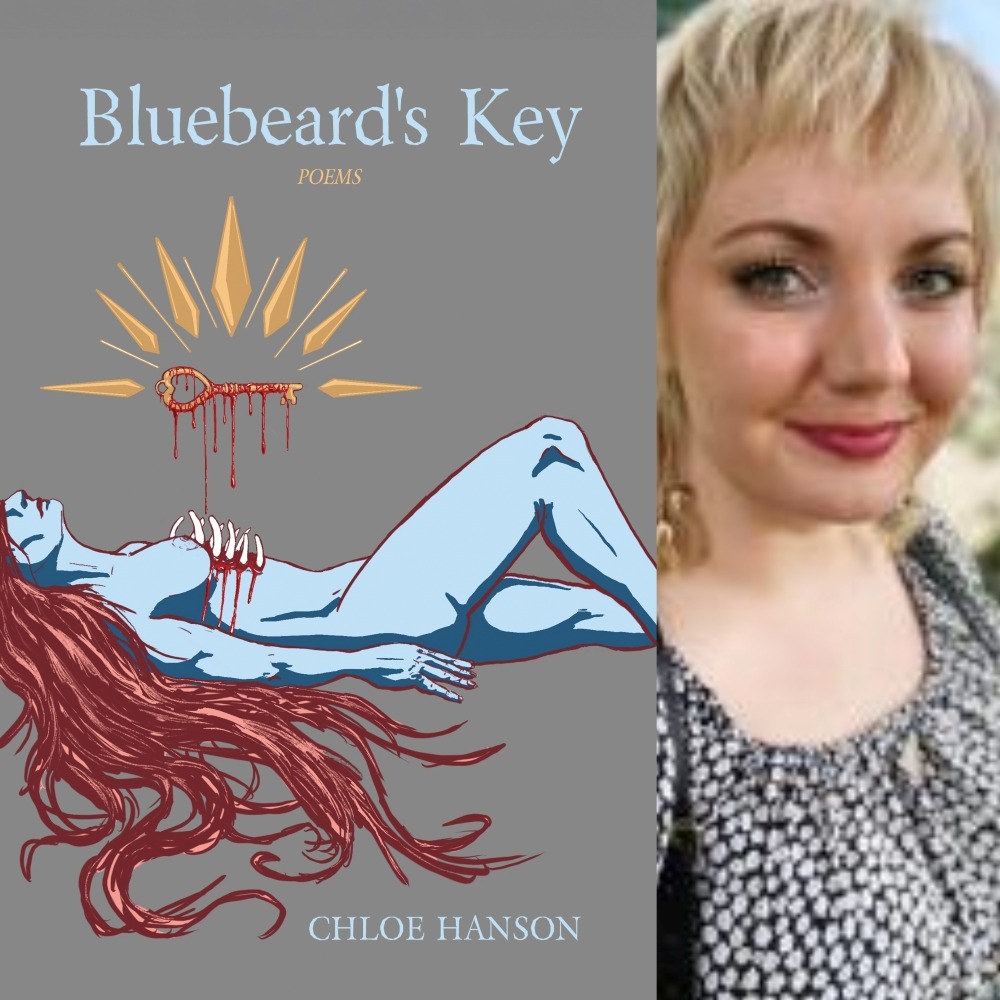
Chloe Hanson earned her PhD in Creative Writing from the University of Tennessee. Her work has always been informed by her interest in the parallel and overlapping oppression of marginalized humans and nonhuman animals. Bluebeard’s Key examines that relationship through the lens of re-told fairy tales. Her work has also appeared in numerous publications, including The Rumpus, Fairy Tale Review, and Glass: A Journal of Poetry. @lemonworld1991
PRAISE:
Bluebeard’s Key is good dynamite! Chloe Hanson’s poems embody the struggles every real heroine faces––how to love, how to stay away from the predators, how to create her own tales and triumph. “See if the girl has learned to run,” to escape the wolves in every tale. Better yet, she has learned to sing and create, to leap into her own story––to find the weapons she will need in a merciless world. Hanson’s finely sharpened words are crafted to protect her every step of the way, every line, every song, every path through today’s merciless forest. She’s our heroine, vulnerable enough to let us hold her hand as she creates her escape route, her own fairy tale that is all too human.
–Marilyn Kallet, Even When We Sleep, Black Widow Press.
In Chloe Hanson’s Bluebeard’s Key, we embark upon a fairytale journey of a girl becoming a woman. While encountering scenes of aggression and danger—often sexual, she negotiates her own bewildering landscapes of desire, guilt, hope, and loss. Scenes from “real life” are reassembled into mixed-media fables, with all the charms, terrors and imagery that fairytales offer. We find powerful lines like: “From behind the grill no one sees what happens in the playhouse. / . . . The place we ate live ants. / Neighbor Girl guarantees they taste like lemon.” And, “There is the sound of song, too far off / for words. Or perhaps I give the wind / too much credit for the shape of its mourning.” Jack finds gold at the top of the bean stalk, but his cow, Milky White, is headed for the slaughterhouse. With unflinching vision, we witness the violence underpinning contemporary culture and the chance that honesty offers, to begin again, to make things new.
–Michael Sowder, author of Sacred Letters
Reviews
There are no reviews yet.