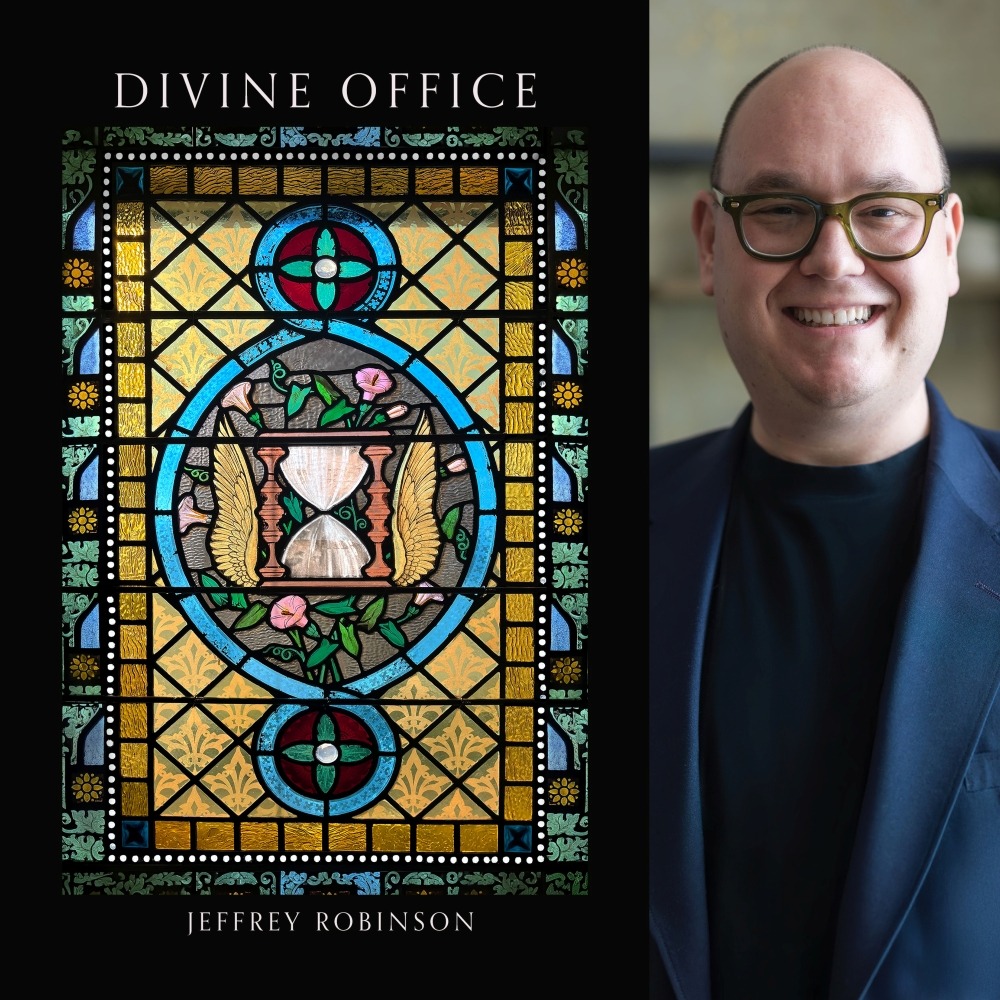
Jeffrey Robinson is a writer, screenwriter, arts leader, and educator based in Boston, Massachusetts. Originally hailing from both the Endless Mountains of Northeastern Pennsylvania and the Piney Woods of East Texas, he has lived and worked in New England for the past twenty years. His poetry has appeared in Journey and The Paddock Review, and his screenplays have been optioned by Hollywood producers. He currently serves as the Managing Director of GrubStreet, the nation’s leading literary arts nonprofit and center for creative writing. Divine Office is his debut book of poetry. Visit www.jeffreyrobinsonwriter.com for more information and news on his work and events.
.
.
In Robinson’s formally and lovingly conceived collection of 32 sonnets, Divine Office, the golden thread of connection remains uncut in spite of living in such a troubling world as ours. Grounded in the poetic conceits of the metaphysical poets, Robinson’s contemporary voice resounds with reminders that grace can be found through our attentive relationships to one another, and what we’ve created. “Breath becomes a bell the heart can hear,” chimes the first Sonnet, “First Light/First Breath” And while I first read these poems quickly and in delight for their formal qualities and imagery, I’ve since returned to them for their balm: “This light is not a thing to chase or keep,/But something lived—through word, through choice, through care./ It wakes the soul that’s buried under sleep,/And draws us toward the good that’s always there.”
–Deborah Schwartz, author of Wind of the House, Voice of the Stream, of the Dream That You Dream, While We Turn You Around
“There is so much life and hope to be shared in these sonnets. Divine Office speaks to the depths of life. For me, Robinson’s poetry brings back a feeling of peace and hope for the world, and this work will do the same for all readers.”
–Sister John Michelle Southwick, IHM, Counselor at Marywood University.
Divine Office is a stunningly poignant and sequence of poems that offer balm for the soul, whispered prayers, incantations, invocation, and a fearless call to action in an inner and outer world that seeks repair – and yet these lyrical sonnets offer solace, reassurance, and a reminder to gather rosebuds, to not go gentle, to ease our mind, and savor the sweetness of grace.
–Susan Campbell Bartoletti, author of The Book of Bee: A Story of Great Peril and Stout Hearts
.
Two historical structures – the canonical hours and the sonnet – play off each other in these beautifully wrought poems. Though each section opens with a prayer, Robinson uses more contemporary language to explore the contrasts between darkness and light, doubt and courage. Part meditation, part manifesto for social justice, this cycle of poems ends up in a hopeful place: “The world is dark, and yet the dark can’t stay – Not while the light keeps finding out a way.” Glory in discovering how traditional religious and literary forms speak to our modern world.
–Clara Silverstein, author of Above the Fall Line


Reviews
There are no reviews yet.