

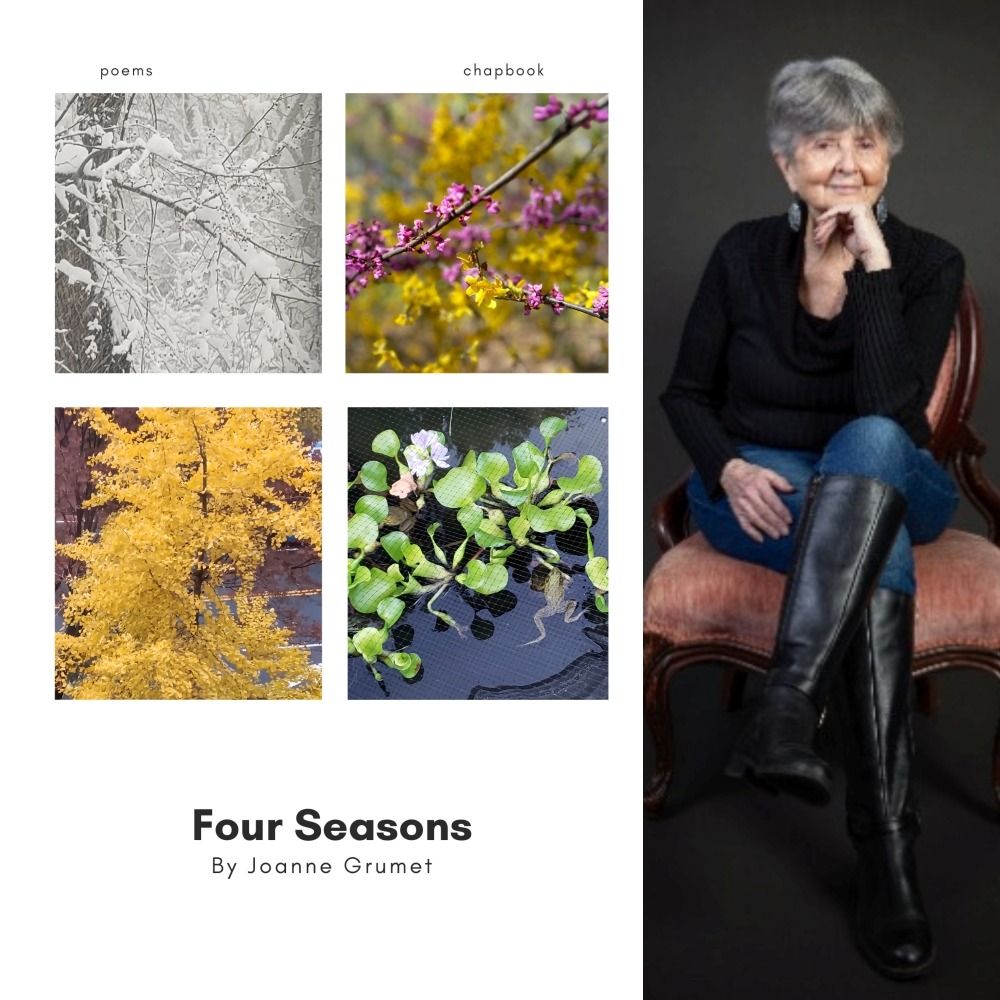
Joanne Grumet began her career analyzing language as a linguist, educator, lexicographer, and professor, teaching Linguistics and Writing to Non-native Speakers. She brings a scholar’s precision to the evocative world of poetry and song, having turned to creative expression later in life as a way to navigate life’s complexities. Rooted in the everyday, Grumet maps the vibrant connection between the natural world and the urban environment. She is also the author of the chapbooks Garden of Eve (2020) and A Mirrored Quilt (2025), with verse featured in over thirty international journals and broadcast media.
.
PRAISE:
.
Four Seasons is a frank reckoning with human frailty and mortality, “the door always there/ is now ajar,” as well as a celebration of mature sensuality and rootedness in the temporal world, where a “beech tree/ thin as the base/ of a music stand” is writing a sonata “across the snowy/parchment/ of the field.” With humor and humility, Joanne Grumet wonders if she’ll still have gut feelings after some of her gut is surgically removed. The same empathic eye falls to rest on a homeless woman on the sidewalk, “Encamped where Victoria’s Secret/ used to be…combing and combing that lock of her/long dark hair” and settles with joy on the red petunias the poet plants “in the soft rain/as I work, myself planted/ deep into life.”
–Hilary Sideris, author of Calliope (Broadstone Books)
.
In Four Seasons each word is set on a poetic plate before us like an horsd’oeuvre, or like a polished stone in a rock garden, with a Haiku sensibility, but liberated from the accounting of syllables. Look for structure only in the bigger picture, succinct poems gathered carefully into four baskets of messages by their seasons. Each image is a photograph in words, taken somewhere between anywhere-USA urban city and open wild country. “Never thought I’d fall in love with a little glass jar” tells us a love story, short and simple, about being captivated by a small jar of tangerine spread, imported from Dalmatia. A moment captured in time. In “Darkness” she describes a doe and fawn, but adds, “cut off from their world in my box of brick, wood, and glass, I watched them, like a hunter in his blind or king in his palace….” A telling lament of isolation. And yet we find that this sparse pallet only serves to whet the appetite for a savory poem like “April’; “A forsythia bush, yellow as a school bus, waves its branches in the breeze, like the happy arms of children released from school.” Grumet’s poems, with their skillful use of understatement, heighten our appetite for life’s joys and sorrows.
–Evan Pritchard, author of Greetings from Mawenawasic (Foothills Publishing), A Silver Feather, a Collection of Ascendant Poems (Resonance)
.
The seasons come and go, and with them our passions and our loves. Joanne Grumet is watching, feeling, writing, and we are in her debt precisely because her poems remind us to keep doing the same, if we can.
–Bill Zavatsky
Reviews
There are no reviews yet.