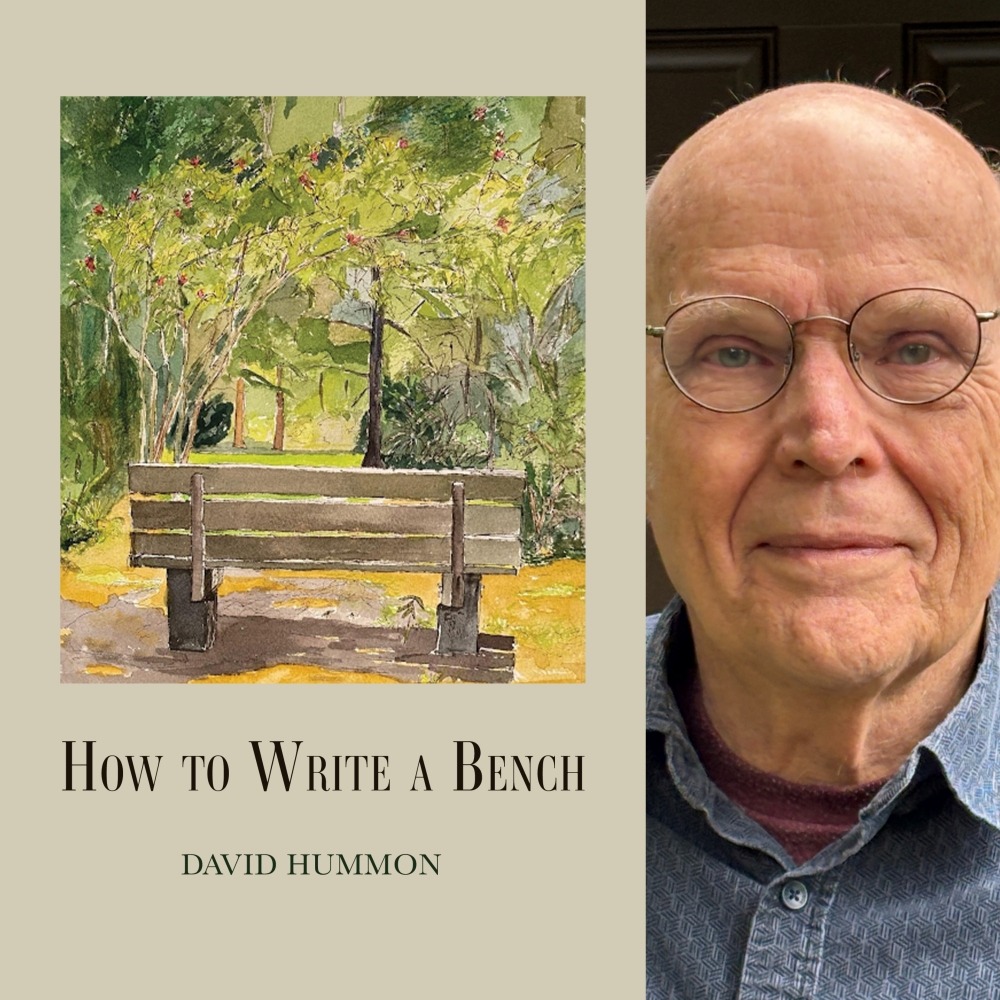
David Hummon’s How to Write a Bench is a deeply self-reflective collection of poems on family legacy, aging, joy in daily life, and the challenges of writing poetry and making visual art. The poems are seamlessly interwoven with Hummon’s beautiful watercolors, drawings, paintings, and prints. A vivid portrait emerges of a person alert to wonder, resilient in the face of physical and emotional suffering, and sure of his poetic vision. In the compelling title poem, Hummon presents us with an ars poetica: a sturdy bench (which also figures in the gorgeous cover watercolor) is a place for refuge, connection, joy, and contemplation, and its simplicity and accessibility is its strength. However, Hummon doesn’t shy away from the more challenging aspects of the craft. His language in “At the Arboretum” echoes the gorgeous cadences of Hopkins in “Pied Beauty.” His sonnet “The Meeting” beautifully masters the form in its rhymes and turns. Hummon can also be inventive, as in “To My Sketchbook”, emotionally deft in poems about age and infirmity, perceptive about the work of other artists, and often humorous. His artwork brings deep pleasure to this book. From the bench to a vase of sunflowers to portraits of family and a weary pair of shoes, Hummon shares with us his joy and empathy.
–Teresa Cader is the author of four award-winning collections of poetry, including At Risk, 2024, the recipient of the Richard Snyder Memorial Book Award.
How to Write a Bench is an expression of poetry and art from a person of deep knowledge and sensitivity. David Hummon is both a talented watercolor artist and poet. His work reveals his brilliant artistic vision paired with deep care for the way his words welcome the art and add to it, resulting in a book that gives the reader the gift of ekphrasis, a dance between art and language.
–Lee Desrosiers, author of Keeping Planes in the Air (Salmon Poetry), https://loridesrosierspoetry.com
How To Write a Bench welcomes us into the company of a painter, poet, and master storyteller. Hummon’s lines revel in layering the literal with the literary, like memories of “doing chores and Ohio mud, potatoes, / a high school teacher who cared, and Shakespeare.” His sure-footed stanzas interweave image and phrase with trademark irony. (“Worshiping more than one god often takes long lines.”) Meanwhile his eye for scene, as well as detail, provides a grounding for grief and wonder in the same poems. The physical becomes a subject, a lens through which the poet can view his father’s death, as well as his own experience of illness, ability and disability. Throughout, Hummon’s artist’s gaze focuses on relationships. He writes from family portraits; from museum masterpieces; from historic photographs; from his own works—not always easy. “Watercolor, wet-into-wet, is risky, / like a simile or driving into Boston.” With hat-tips to writers like Whitman and Smart, David Hummon invites us into conversation with artists, family members, and even the muse. It’s an invitation we don’t want to refuse.
–Jessie Brown, author of Lucky and What We Don’t Know We Know


Reviews
There are no reviews yet.