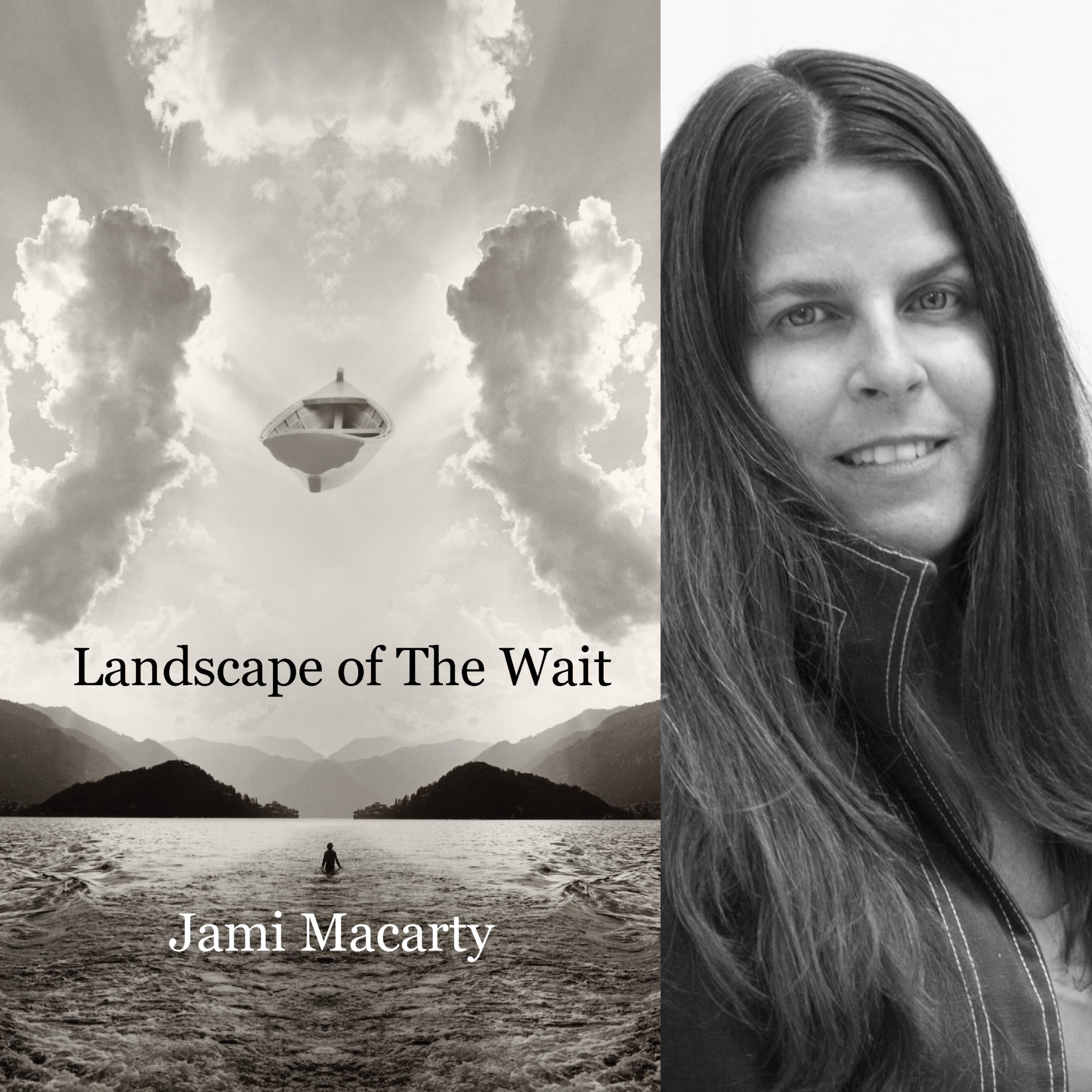
How to write of emergency. Of trauma. Of a boy in a coma surrounded by those who care. Who care to find him. Jami Macarty, the poet among them, writes her way toward him with a scorching, visceral language. Her poems try to make contact from every direction and so the poems are heterogeneous, their myriad structures probing. The unsettled grammatical connections, the caesuras rehearsing loss, the vowels howling in rhyme from either side of the gap, the skips in the language— into into into— enact all the energies of living in that extended moment of suspension when we simply don’t know what happens next.
–Forrest Gander, author of Core Samples from the World & The Trace
In this “landscape,” the experience of waiting ceases to be mere concept, ceases to even be merely a topographic condition to be observed. Landscape of The Wait inevitably, inexorably, becomes a mirror, and the reader will see herself mirrored in it. But it does more. We are offered the landscape of crisis as a mirror of not only our own human condition, but of the ways that our normative human conditioning will be torn through by radical and irreversible change. There is, perhaps, a kind of freedom in that terror, though one that none of us would willingly choose. This is the kind of hard-won awareness, the kind of subtlety and complexity, that these poems achieve. Though the poems navigate a crisis specific to the speaker, which is exactingly portrayed, the reader can find in this text insights into some of the largest questions we ask of life, and of death. Each poem uses its form as a unique figure of inquiry—sometimes precociously, sometimes with a profoundly moving sadness. What is found in this poet’s deft delving into the unknowable is never a completion, never a finish, but rather a map for furthering the investigation. These are beautiful, brilliant poems exposing us to the fullness of a fierce and compassionate, never complacent, intelligence.
–Rusty Morrison, author of After Urgency & Beyond the Chainlink
From the trauma of ruin, Jami Macarty tries to make sense. The more delicate and beautiful these lyrics are the keener we feel the double-edged blessing and wound of living in a human form. The quiet vigil beside the body of the comatose nephew finds its analogy in the writer and reader desperately attending the language of the poem in deep hope of finding some comfort there.
–Kazim Ali, author of Bright Felon & Sky War
Review at Panoply -- https://panoplyzine.com/


Reviews
There are no reviews yet.