

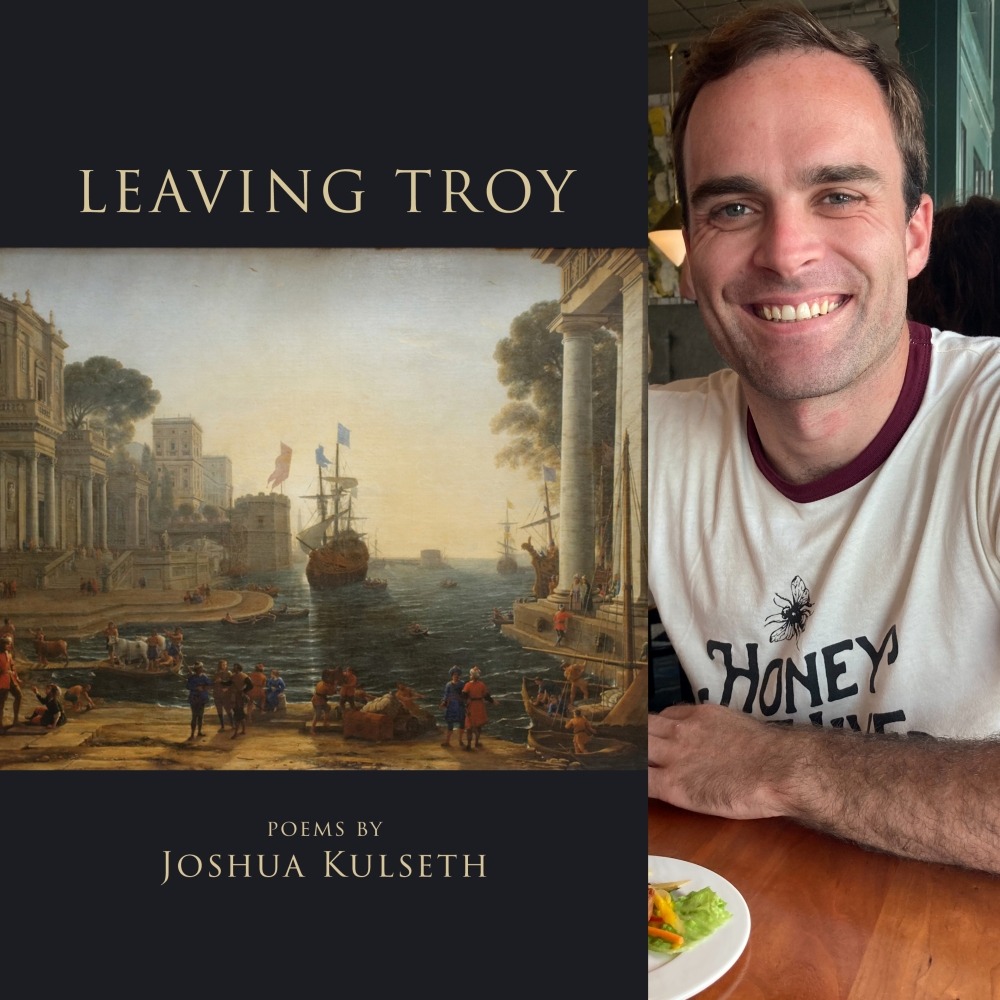
Joshua Kulseth earned his BA in English from Clemson University, his MFA in poetry from Hunter College, and his PhD in poetry from Texas Tech University. He has co-authored two works of criticism and non-fiction—Agony: Brazilian Jiu Jitsu and the Greeks, and W.H. Auden at Work: The Craft of Revision. He is currently Assistant Professor of English and Creative Writing at Franciscan University of Steubenville.
PRAISE:
“Handling narrative and reflection with equal skill, Joshua Kulseth ferries us through New York City subways, Southern railroad crossings, a family homestead stewarded by generations, the pangs of eros, and waverings of spiritual commitment. Yet these sites mingle—often in the same poem—with the ancient calamity of Troy, casting present-day “history-sickness,” individual and societal, in the regenerative light of myth. As with Troy, love and violence are intertwined, as testified in the poem “Ajax,” where the mythical warrior, here translated to a bunk mate in a boarding school for troubled teens, “took me / by the throat and growled, if you don’t see people with love, / how do you see them? and weeping, / threw me to the floor.” In Leaving Troy, the ancient city follows us, for within and without the walls of the heart, Troy is ever falling, and ever being rebuilt, as we are ever “broken and renewed” by the agon of our being in this life. Through the masterly craft of poems like “Words Like Ours,” Kulseth gives us confidence that our words can carry out this renewal.”
–William Wenthe, author of The Gentle Art and God’s Foolishness
“Whipsmart, entertaining, learned in a way that doesn’t preen or pat itself on the back, Leaving Troy is that rarity of rarities: a first book that is so self-assured and so abundant in its gifts that you forget anything but the pleasure of discovering a fully developed sensibility; and what’s more, a sensibility that transcends the various period styles and achieves its own tonal originality. Gifted at portraiture, Kulseth presents a wide-ranging gallery of beautifully depicted ancestors, of familiars from childhood and adolescence, of lovers, and of people who happen to live on the street—not “streetpeople”, not “the poor”, profoundly not “the marginalized”—but fully drawn human beings whom the poet never sentimentalizes or turns into symbols or well-meant cliches. His modesty in acknowledging the limits of his own subjectivity is matched by his shrewdness of observation. Most importantly, words like Kulseth’s—and his style, ranging from the downhome to the eloquent to the satiric (especially the self-satiric) demonstrates in every line his devotion to what Osip Mandelstam once called “the steadfastness of speech articulation.”
–Tom Sleigh, author of Space Walk and The King’s Touch
Reviews
There are no reviews yet.