
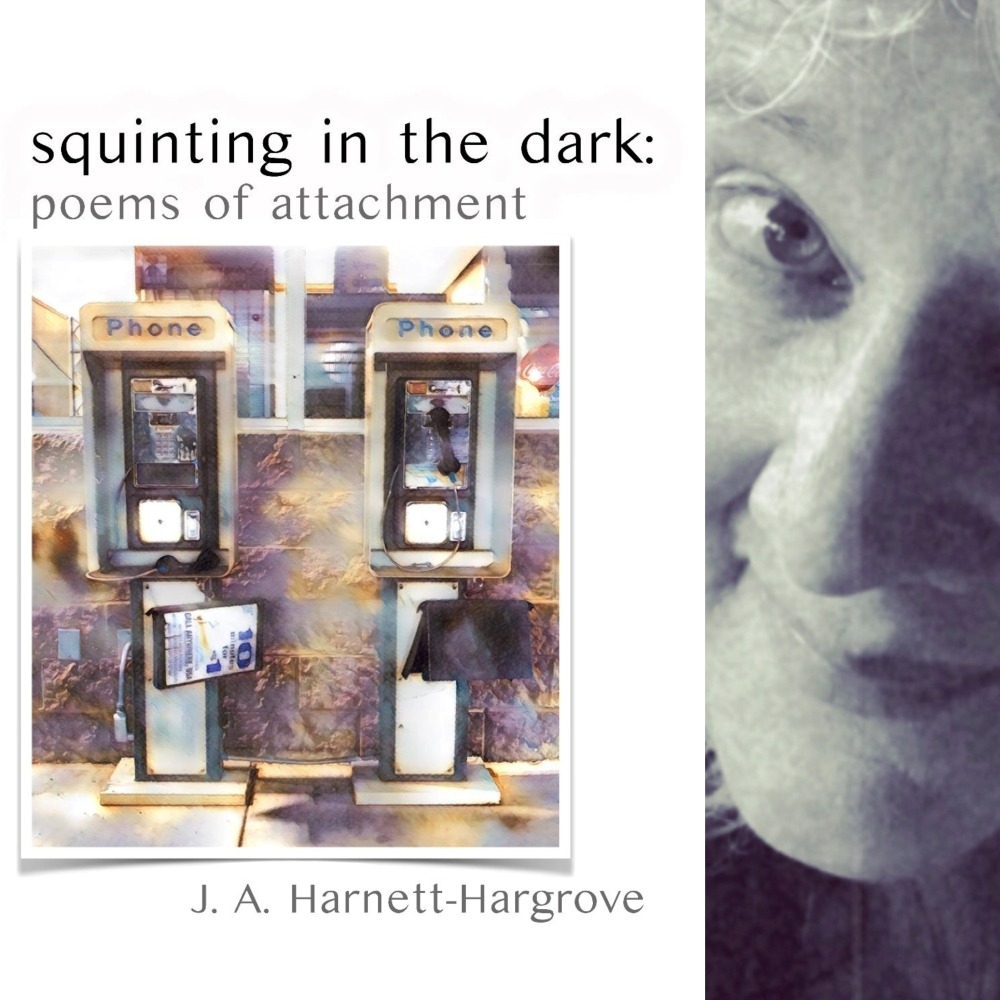
Harnett-Hargrove is a poet and visual artist whose work refuses linear time, clean categories, and is built in quiet disruption. They write with scissors, sketch in sentences, and name the fractures most people walk around.
PRAISE:
Any single poem blinking out at us from Harnett-Hargrove’s Squinting in the Dark may take flight from the realm of the personal, or the philosophical, or the phenomenological objecthood evoked by Haiku; by the time the poem lands, it will have borne us through all three. We might begin with sharply observed details of daily life, or the sharply honed observations of the traveler (in one case sharpened by familiarity, in the other by its opposite), but find ourselves insensibly led by association + image into regions of dream thought or spiritual aporia. The poem’s experience is an accumulation of sensation + meaning, a collaging of images and language, emphasising that experience accumulates as we inhabit it emotionally, intellectually, practically, + aesthetically. Yet, as this plenitude of experience overflows, it merges with loss, is sublimated into the apprehension of mystery + the unconscious that provides the frame against which the moments of these poems are set. In them, the poet registers the eddies + flows of these elements of experience, in which physical sensation merges with subjective sense, where experience merges with + emerges from reflection, emotion, + memory in both its personal + cultural levels. The storehouses of dream open onto the real, + some of the poems have grown directly from dreams; for they show us how they percolate through and within the mundane – for experience comprises + merges them both.
–Olchar Lindsann
A Whirlwind. What happens when an artist, accomplished for her visual work, including costumes, paintings, and large scale immersive pieces, adds poetry to her repertoire? In “Squinting in the Dark”, there are detonations, and explosions. Light bursting through blackness. Surrealism in paintings always evokes a visceral response; we don’t *think* about our response to the art; we simply *feel* it. Ms. Harnett-Hargrove has created a surrealist landscape of letters where love, death, suicide, monsters, other-worldly creatures and puns, all collide. There is much darkness and there is dark humor here, too…I could quote verses here, but part of the excitement in these tightly wound phrases of hers is in the discovery that each of us will make, as we absorb them. That is how it will feel: the words here will become a part of you, long after you close the book…And when you close your eyes, many of the images described— some fractured and deliberately left “unfinished”— will haunt you, and some will amuse you. I plan to read this delightful chapbook a third time. Not to *understand* it, but to experience it, again. Immersive poetry. Words that are like tornadoes. Words you may be tempted to try to navigate through, but please don’t. Instead, let them take you through the torrent. The air will calm, and you may find yourself chasing these words; you may chase the storm of words here, just to experience the feeling of being swept-up, again.
–Lisa Nanette Allender
Lisa Nanette Allender –
“Squinting in the Dark”,
by Jayne Harnett-Hargrove.
A Whirlwind.
What happens when an artist, accomplished for her visual work, including costumes, paintings, and large scale immersive pieces, adds poetry to her repertoire? In “Squinting in the Dark”, there are detonations, and explosions. Light bursting through blackness.
Surrealism in paintings always evokes a visceral response; we don’t *think* about our response to the art; we simply *feel* it. Ms. Harnett-Hargrove has created a surrealist landscape of letters where love, death, suicide, monsters, other-worldly creatures and puns, all collide. There is much darkness and there is dark humor here, too…I could quote verses here, but part of the excitement in these tightly wound phrases of hers is in the discovery that each of us will make, as we absorb them.
That is how it will feel: the words here will become a part of you, long after you close the book…And when you close your eyes, many of the images described— some fractured and deliberately left “unfinished”— will haunt you, and some will amuse you.
I plan to read this delightful chapbook a third time. Not to *understand* it, but to experience it, again.
Immersive poetry. Words that are like tornadoes.
Words you may be tempted to try to navigate through, but please don’t. Instead, let them take you through the torrent. The air will calm, and you may find yourself chasing these words; you may chase the storm of words here, just to experience the feeling of being swept-up, again.
Ann Cunningham –
Jayne’s work, be it written, sculpted or drawn is dangerous. As soon as I get near it, it explodes in my mind and I am lost for who knows how long before I find my way back. But it is always an amazing and valuable adventure. I can only say you are missing out if you don’t book a trip soon.