

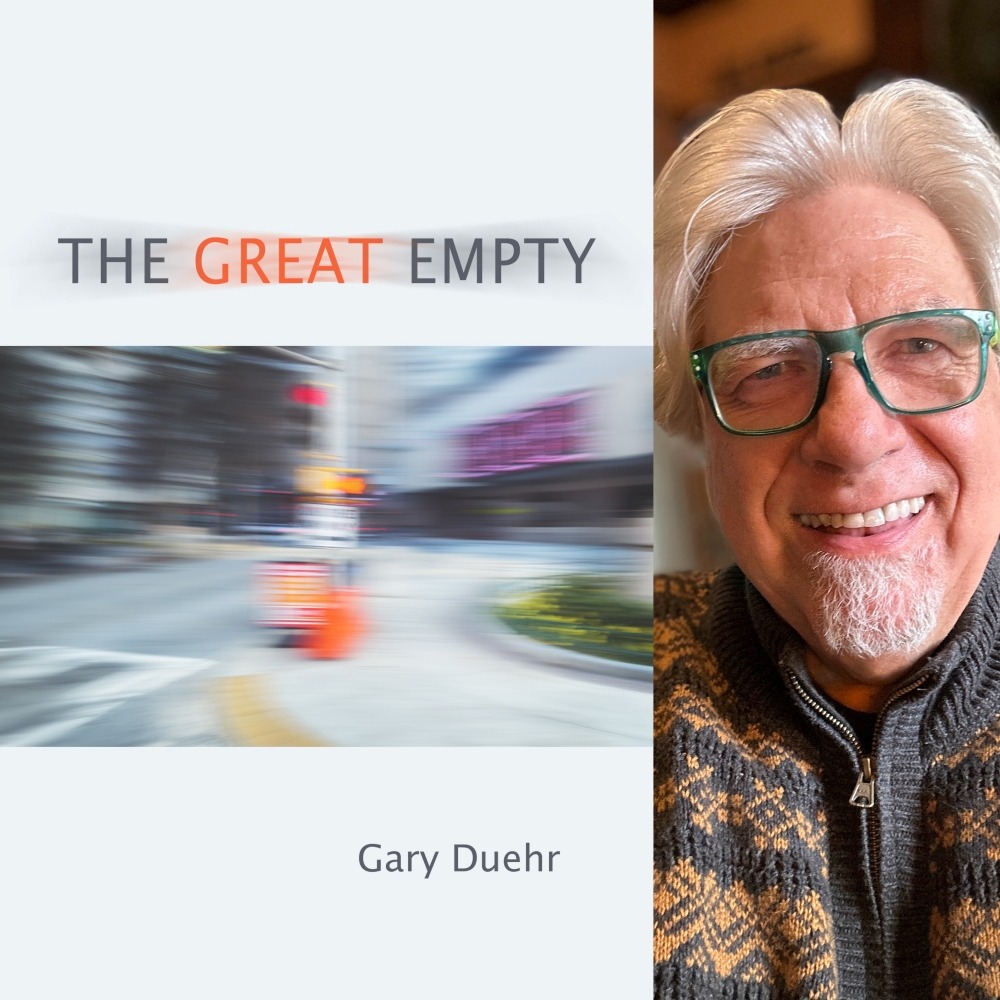
Based in Boston, Gary Duehr teaches writing for local universities. His MFA is from the University of Iowa Writers Workshop. In 2001 he received an NEA Poetry Fellowship, and he has also received grants from the Massachusetts Cultural Council, the LEF Foundation, and the Rockefeller Foundation. His books of poetry include Point Blank (In Case of Emergency Press), Winter Light (Four Way Books) and Where Everyone Is Going To (St. Andrews College Press). His children’s book in verse is Felicia the Ferret and the Atom Smasher (Thurston Howl Publications). His short stories have appeared in numerous journals, and his plays have been presented by Boston Playwrights’ Theatre in Boston and by the Equity Library Play Festival in New York.
PRAISE:
Years after its peak, the COVID-19 pandemic will not leave us alone, much as we’d like to imagine its legacy is null. The Great Empty is an evocative contribution to the literature of that cataclysm. Gary Duehr vividly evokes the alienation and social abandonment which marked its onset, recalling what it was like when we learned it had gone far beyond a cruise-ship infestation. But the voice of this work does not settle for despair. The formal elegance and meditative quality of renga allow us space to attend to not only what disappeared, but also to what remains, to points of affirmation that are also still real. We need every strategy for resilience we can find.
–David Miller, author of Bend in the Stair and Sprawled Asleep
The spring, summer, and fall of 2020, we lost a half million people to the corona virus. We who lived through those early days of the pandemic feel it has changed everything, but we find it impossible to specify the change. We ask ourselves how to remember, witness, make sense of those months which seemed to have opened a chasm between past and future, or, in the words of Gary Duehr, “Before/After, Then and Now,” We feel it must make sense, and we find our stabs at finding meaning frustrating and elusive. Now, in a marvelous and variegated tapestry of poems, Duehr has, with wit, vividness, and astuteness, given us the generous gift of The Great Empty as a kind of log of the first year of the plague, fashioned from his own experiences, sensations, emotions, thoughts, memories, and immediate and historic events. The largest mystery he confronts is the dull passionless stupor he diagnoses as the condition of our people in response to the pandemic. He weaves his tapestry together by a brilliant adaptation of the haiku-like Renga form, traditionally a conversation between collaborating poets. This Renga is an internal collaboration of Duehr with himself in which he adopts the role of a detached witness who contemplates an incredible variety of material bravely and honestly and enacts a kind of secular prayer, “Save our starving soul.”
–Bernard Horn is the author of Love’s Fingerprints and Our Daily Words.
Reviews
There are no reviews yet.