

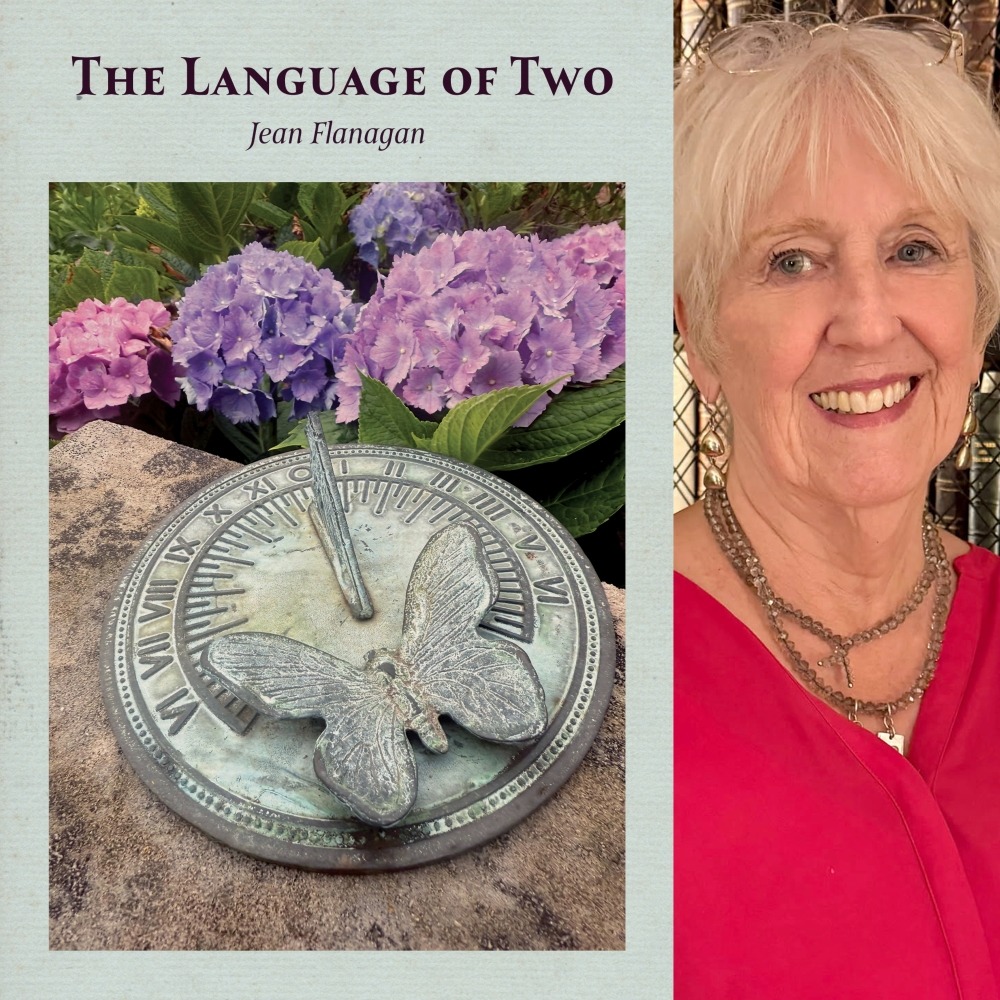
Jean Flanagan is the author of two books of poetry: Ibbetson Street (Garden Street Press) and Black Lightning (Cedar Hill Books). Her forthcoming book A Hard Winter for Living will be published by Cervena Barva Press in 2026. Flanagan is a volunteer coordinator for “Changing Lives Through Literature” an alternative sentencing program in Massachusetts. She is one of the founders of the Arlington Center for the Arts and the current Poet Laureate of Arlington, Massachusetts.
PRAISE:
In Jean Flanagan’s first two poetry collections, the sweeping History of Ireland and its diaspora hover above the texts. But here––in her new book, The Language of Two––the poet focuses on those small-h histories within which most of our lives take place: relationships, marriages, and love’s tumultuous fate; memory, and the fierce emotional weather that shapes it over decades. Seemingly ordinary details slowly take on far greater resonance. And thus these poems catch us by surprise; they begin in moments of quiet intimacy and then suddenly reach toward the universal. Jean Flanagan understands that in keeping faith with the modest details of everyday existence, we glimpse (on occasion) the most substantial and vibrant truths.
–Steven Ratiner, Grief’s Apostrophe
In this new collection, poet Jean Flanagan deftly navigates between the personal and the historical to focus on the multi-faceted prism of loss. Objects and images resonate in these pages: a sculpture, the sun’s shadows, flat stones, a blue and white sundress, sandals with diamonds and gold bling. Grief – a “haunting melody” – saturates our lives. Yet, despite the bruising remnants of pain and regret, Flanagan assures us that “miracles are born here among the purple wild orchids.”
–Shirley J Brewer, author of Wild Girls and Goddess of Swizzle
As its title implies, Jean Flanagan’s moving book deals with personal dualities of many kinds: love and lost love, marriage, family connections and elegies. Her poems can be painfully intimate, as in “Dancing With Alzheimers,” where the wife mourns over her husband’s clothes. They also broaden beyond the personal to engage with historical figures, as in the title poem; to celebrate her Irish heritage; to reflect her strong sense of local place. These poems are full of truth, unflinchingly reported. Like the trombone music in “The Player,” they “dance near the edge” and “echo in the night air.”
–Susan Donnelly, Author of The Maureen Papers and Other Poems
NEWS, REVIEWS AND MORE:
Reviews
There are no reviews yet.